
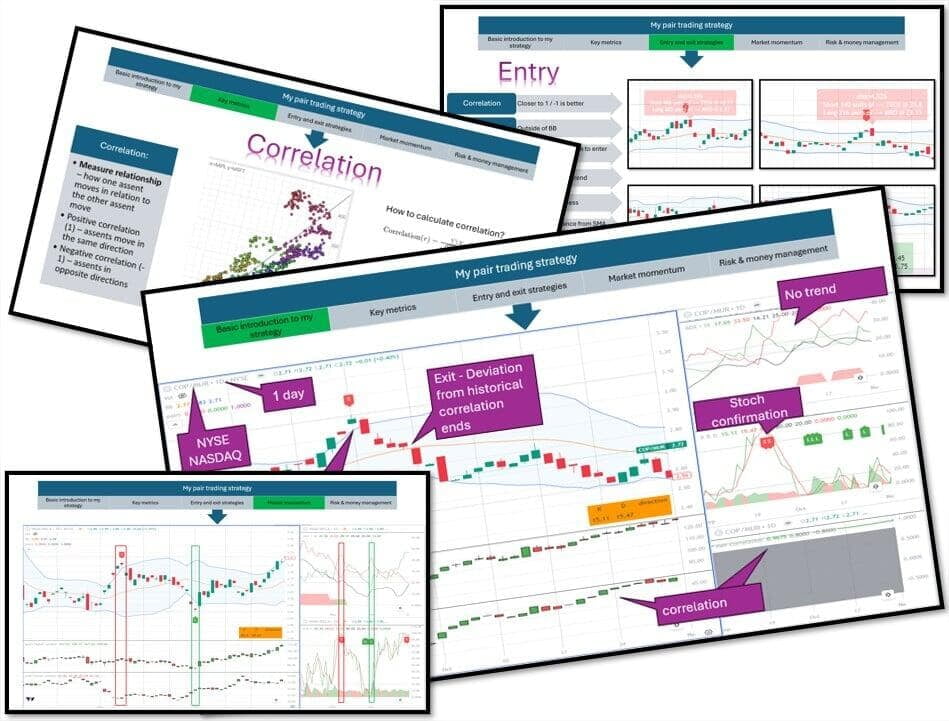
Trading the stock market can feel overwhelming at first. Prices shift rapidly, and small errors can incur costs. Pairs trading offers a structured approach that helps beginners trade with defined rules rather than guesswork. It’s considered a market-neutral strategy. With this, you focus on the relationship between two stocks rather than predicting overall market direction.
This guide describes the best pair trading stocks strategy and explains how pairs trading works in practice. You learn about common beginner mistakes and how to start understanding them with simple videos and examples.
How Pair Trading Actually Works
Most introductions explain the pair trading conceptually. Here’s what it looks like with real numbers.
Example: KO vs. PEP (Coca-Cola vs. Pepsi)
These two stocks typically show high historical correlation.
Between January and March, their daily percentage returns moved together roughly 82% of the time.
In mid-April, KO outperformed PEP by 2.1% in a single session, well above their usual spread variance.
A pairs trader doesn’t guess that the gap “should close.” They check three things:
Correlation stability (not one-week noise).
Direction of divergence (price or return spread).
Standard deviation of the spread.
In this case, the KO-PEP spread moved to +1.9 standard deviations, which historically reverted within 3–5 days.
A typical trade setup might look like:
Short KO (the outperformer).
Long PEP (the underperformer).
But only after confirming that the correlation hasn’t broken due to news, earnings, guidance, or fundamental shifts.
The goal is not predicting the market, but tracking how far the spread has moved relative to its historical behavior.
What Makes a Pair Suitable for Beginners?
Instead of broad statements like “pick correlated stocks,” here are objective factors traders actually check:
1. Correlation above 0.75 over multiple lookback periods
Check 30-day, 90-day, and 180-day windows to ensure the relationship is stable.
2. No asymmetric fundamental events
Example: If KO releases earnings today and PEP reports next week, the spread may move for valid reasons, not mean reversion.
3. A spread that behaves like a stationary series
Some traders check for cointegration, but beginners can focus on:
Consistent Mean.
Predictable variance.
Repeated reversion cycles.
Without this, divergence may continue longer than expected.
Step-by-Step The Best Pair Trading Stocks Strategy
Here’s how a beginner can approach pairs trading:
1. Find a Pair
Choose stocks that:
Are in the same sector (banks, energy, retail, etc.).
Have similar market capitalization.
Show consistent correlation in past price movements.
2. Track the Spread
Calculate the difference in price movement or percentage change. You can use charts or simple spreadsheet calculations.
3. Define Entry and Exit Points
Enter when the spread is wider than normal.
Exit when the spread returns to average.
4. Test Before You Trade
Use historical data to practice your approach.
Small trades or paper trading can help you learn without risking much.
Common Beginner Mistakes
Even the best pair trading stocks strategy can fail if you make basic mistakes. Beginners often:
Pick stocks without checking correlation.
Ignore transaction costs and fees.
Trade too large or too quickly.
Skip stop-loss rules.
Chase quick profits instead of consistent setups.
Avoiding these mistakes helps you build steady skills.
Learn With Power Pairs Videos
Power Pairs offers beginner-friendly videos to help you understand pair trading clearly. The lessons show how to track stock relationships, analyze price spreads, and identify potential entry and exit points.
See real examples of stock pairs in action.
Watch mini-trades explained step by step.
Learn to monitor the price gap without guessing.
These videos focus on practical, example-driven explanations. You can pause, take notes, and practice along with real market data. Power Pairs keeps explanations simple but accurate, helping beginners build skills gradually.
The goal is to make trading less confusing. Each video shows clear steps and real trades, so you understand how pair trading works in a controlled way.
How Video Lessons Help
Watching a trade setup can make it easier to understand:
How to measure price gaps.
How to spot correlated stocks.
How to plan entry and exit points.
Beginner videos often show real examples of trades using stocks like KO/PEP or MA/V. Seeing the strategy in action helps you practice safely.
A Mini Case Study: A Failed KO/PEP Trade
A realistic example is more useful than a perfect one.
In July, KO dropped after a weak demand forecast.
PEP held stable.
The spread widened beyond +2 SD.
Many traders entered assuming reversion.
But the divergence was fundamental, not statistical. The spread never returned to the original mean until after earnings.
Lesson:
Statistical setups fail when macro or fundamental catalysts invalidate the relationship.
This single scenario helps beginners understand why pair trading must be data-driven, not pattern-driven.
Start Practicing With Real Examples
To build confidence:
Pick one pair to monitor daily.
Record the spread and watch patterns.
Execute small trades or simulate trades on paper.
For example, Bank of America (BAC) and JPMorgan (JPM) often move together. A temporary divergence can be a learning opportunity.
Key Takeaways
Beginners benefit from structured rules, historical data, and manageable risk.
Avoid common mistakes: ignore correlation, skip stops, or trade too large.
Video lessons and real examples accelerate learning.
Using simple tools and a journal improves tracking and skill-building.
Pairs trading is not a guaranteed way to profit, but done carefully, it teaches beginners discipline, pattern recognition, and risk management.
Next Steps
Start small. Pick one sector, choose a pair, and track the spread. Watch beginner video lessons showing real trade setups. Practice with simulations before committing real money. To make pair trading clearer, you can follow real-time stock pair charts and mini trade examples. For instance, KO/PEP (Coca-Cola/Pepsi) or MA/V (Mastercard/Visa) pairs show how price gaps form and close.
Tracking these pairs helps you understand:
Entry points: when the spread between two correlated stocks reaches a target.
Trade execution: Buying the underperforming stock while selling the outperforming one.
Exit points: Closing the trade as the price gap normalizes.
Practical lessons: How volatility, fees, and timing affect profits.
Watching real examples turns theory into actionable steps. You see patterns, practice proper timing, and apply rules with more confidence.
Conclusion
New traders can create and test the pair trading stocks strategy, which focuses on highly correlated stock pairs. Pairs trading helps beginners learn structured decision-making using correlation, spread behavior, and defined risk rules. Start by tracking one reliable pair, studying its historical spread, and testing your entry and exit levels in simulations. Use beginner videos only as a visual guide, but base your trades on data, not assumptions. Small, consistent practice builds the skills needed to trade this strategy responsibly.
Beginner traders can learn pairs trading using Power Pairs. Watch the beginner videos and practice with small or simulated setups.
FAQs-
1: What makes a pair of stocks good for pair trading?
A strong pair typically shows consistent historical correlation, similar sector exposure, and a spread that behaves predictably over time. Traders often check multiple lookback windows (30-day, 90-day, 180-day) to confirm correlation stability and ensure no fundamental events like earnings surprises are distorting the relationship.
2: Is pair trading risk-free or market-neutral in all conditions?
No. Pair trading is designed to be market-neutral, but it is not risk-free. Correlations can break, fundamentals can diverge, and spreads can remain wide longer than expected. Risk management stops, position sizing, and verifying news catalysts—is essential for preventing unnecessary losses.
3: How do beginners know when to enter a pair trade?
Beginners usually look for a spread that moves beyond its normal volatility range, often measured in standard deviations. For example, a spread widening to +1.5 or +2 SD may signal a potential opportunity but only if the correlation is still intact and no new fundamental information explains the divergence.
4: Do I need advanced statistical tools to start pair trading?
Not at the beginner level. Many traders start by tracking price spreads, correlation, and simple moving averages using basic charting tools or spreadsheets. As skills improve, they may incorporate cointegration tests, z-scores, and automated alerts, but none of that is required at the start.
5: Can a pair trade fail even if the spread looks stretched?
Yes. A stretched spread does not guarantee reversion. Trades fail when the divergence is driven by valid fundamental changes, such as earnings guidance, sector-specific news, or macro events. Your blog’s KO/PEP example highlights this: statistical setups can fail when fundamentals override historical patterns.